Blog

8/12/2020 1:31:22 PM

Take my mind off the pandemic

3 Comments

                                           “Hmmmmm”


Guess what I want to drink lately?


I don’t routinely paint in a photo-realistic style, but recently I wanted to do something that would keep me fully engaged — not dwelling on the pandemic. I poured myself a glass of cold, white wine and sat down to consider my options.


And that’s when it came to me: How about painting a bottle of wine? I’ve heard TV talk show hosts mention that people are drinking more while being stuck at home. That rang true with me. Between engaging in FaceTime Happy Hours with friends and wanting to make at-home dinners special, I have uncorked a fair number of wine bottles in the last month or two. But who’s counting?


I opened my refrigerator to check out what wines were waiting to be painted. I was surprised to find only the bottle I had just poured from. But after rummaging around the shelves, I found a number of interesting other beverages. I was amazed by those bottles’ shapes and colorful labels. 


The “Hint” brand of flavored water was particularly colorful. I also discovered a single bottle of Gold Peak tea my husband bought but never tried. It had taken up space in the frig for months. It was time to put it to use!


Then I found a tiny bottle of Diet Coke. I stopped drinking Coke —diet or not— after reading it could erode tooth enamel and result in weight gain. But my husband, who still drinks both regular and Diet Coke, had hidden one behind a big jar of mustard. I added the interestingly shaped plastic bottle to the mix for my still life.


Finally, I spotted what I had started out looking for in a metal wine holder at the end of the kitchen counter. It was a lovely bottle of Cabernet Sauvignon. I prefer to drink white wine because red gives me headaches and hot flashes, but the bottle’s label was pretty. I often choose wines based on attractive labels. I think the real wine experts do the same, right? This one made the cut, if only for a painting.


Next, I found a round wooden tray to hold the drinks and positioned them so their most colorful sides would show. 


I placed the tray on the dining room table, near a window to light them up. Then, iPad in hand, I was ready to memorialize the composition. Trouble was, the background of the photo was cluttered with my table centerpiece, the tops of chairs, and the china cabinet full of dishes and glasses. What to do?


That’s where the magic of “Procreate” came in. Procreate is a powerful art program designed for iPads. With it, I “erased” all the unwanted clutter in the photo I used as my reference. Even with photo realism, artists often need to edit images to ensure the best compositions. In this case, all the background items did was confuse matters. On the other hand, a reflection in the wine bottle struck me as a great way to portray my choice of beverages during the pandemic. 


I titled the completed painting “Hmmmmm” and wrote the following poem to explain what it was all about:


What do you drink during a pandemic?

Bottled tea over ice?

Would a Coke be nice?

How about fruit-flavored water to hit the spot?

I think not!

A subtle reflection

reveals my selection.


Do you see it?


Until next month, CHEERS!


Read More

7/2/2020 3:54:53 PM

Time changes more than hair color: Check your artwork

Paula Willits / Comment on this


Looks can be deceiving! I’m still a blond from the front, but look what lurks under the surface! 


Due to the pandemic, I’m beginning to see exactly what lies under my blond veneer. What a shock! 


But hair isn’t the only thing that changes with age — your paintings might also be aging. 


Recently, as I rifled through every drawer, shelf and storage container in my house to prepare to move, I found a painting I did 50 years ago. It was a framed scene of mountains dotted with trees. A distant river snaked through it. The medium was charcoal.


Ironically, at that point in my life, “Stone Mountain” in Georgia — a huge, granite rock that had been dragged into the area by an iceberg eons ago — was the closest thing to a mountain I had seen.


But that was nothing like the mountain range in the painting that had hundreds of what I then called “Christmas trees“ that hopefully would never be cut down and decorated. As I examined it all these years later, I still loved the composition.


Suddenly, I noticed one corner of the frame was coming unhinged. And there were gaps in the back, exposing the contents within. I couldn’t resist: I needed to rescue the painting from it’s decaying frame. But as I carefully pulled the frame’s sides apart, the painting began to tear and crumble. In the end, after a few more minutes to reminisce, I sighed and dropped the frame, matting and painting into the waiting jaws of a cruel trash can.


Have you ever had a painting disintegrate? I hope not. 


This life lesson reminded me of how important materials and framing are to preserving paintings. Here are some tips to keep your trash cans available for trash — not artwork. Consider the following before you buy:


1) What medium was used for this painting? Some mediums do not require the protection of glass if they are adequately prepared. For instance:


* Acrylic paintings don’t need to be framed in glass. But ask if they are sprayed, brushed or sponged with a high-quality varnish to protect the surface from UV rays, dirt, dust, smoke and water damage.


* Pastel artwork needs glass as well as a mat or “spacers” to keep the pastel from touching and eventually adhering to the glass. Also, any little flakes of pastel that come off will fall behind the mat so they won’t be seen. 


I was shocked to find that a pastel work in my cabin the last time I took a cruise did not have a glass front. I gingery touched a spot that wouldn’t be noticed and the color came right off on my finger!


* Colored pencil artwork should be treated as the pastel works are: framed in glass with mats or spacers so they won’t stick to the glass.


2) What is the painting’s substrate? In other words, what is it painted on — e.g., paper, canvas, wood? Ask if that surface was prepared so the medium used will stay adhered to it 


     * If paper, was it archival/museum quality? My old charcoal rendering was on cheap drawing paper that had turned from white to yellow over the years. What did I know about such things that long ago? And, in my defense, many art materials that are archival quality now were not yet developed that long ago. (I’m really old! Check out that gray hair above.) 


     * If wood or canvas, was it made ready to accept and hold paint? For instance, the wood could be sanded and sealed before being painted, or the canvas might be coated with gesso to help the paint stick to it. 


Fun fact: I once sanded and added gesso to palm fronds. I didn’t want them to eventually decay after I painted beach and underwater scenes on them. 


3) What does the back of the painting look like?


     * Is it sealed well to protect the artwork from moisture that can cause mold?


     * If it has a mat, is it made of archival material?


     * Are there  little sticky “dots” stuck onto the corners to keep the painting’s frame away from the wall? That helps keep moisture from entering the frame and gradually causing the painting to decay. You can always add those dots yourself before you hang the artwork. They’re inexpensive and easy to find at hardware stores. 


This month’s blog is now a wrap - a tight one even with no glass or mat!

Read More

6/6/2020 3:26:59 PM

A new beginning with a new art studio

Paula Willits / 8 Comments


 The move is over; the work begins


After unpacking about a trillion boxes and ordering a zillion things from Amazon to bring in more boxes, I have an announcement: OUR MOVE TO NORTH CAROLINA IS OVER!


And now the work begins. That is, it’s time to turn this house into a home. And, to be more precise, a bedroom into an art studio.


But the skeleton of a great studio is already in place. My favorite thing? The huge sink you see above.


As some of you know, Richard and I found a house that was already mostly built. But it didn’t yet have a ceiling on the downstairs level. That was great, because it meant the builder could easily bring a water line up to one of the bedrooms on the main floor to give me the ability to wash out my brushes and keep changing the water to mix paints and do all kinds of sloppy things without leaving the room. 


In my last studio, the sink was much too small. I was determined for that not to happen again.


The studio is in the front of the house. A big window there brings in the beautiful morning light, plus it will help me keep up with the house being built across the street. Cinnamon is unimpressed.


My first “work of art” is trying to repair a pot that was cracked during the move. The sink is set into a long cabinet with a granite top which provides a great surface to fill the cracks that weave around the pot. Who knows if I can save it? But nothing ventured, nothing gained.


Here’s another side of the room. In the corner are my trays on wheels that carry the tubes of paints right up to the table and easel. They slide easily because the floor is a sturdy laminate. And it’s speckled to hide the inevitable paint splatters.


Next to the trays, against the wall, is a chest we’ve had for years. It’s also on wheels. The top has 2 panels which slide back in different directions to reveal a mother lode of art supplies as well as towels which really come in handy because the paint tends to fly when I’m waving those brushes! 


Now here’s where I really need help: Who can tell me how to hide those awful cords from my must-have TV mounted on the wall? There’s also a DVD on the chest adding to the cords because I occasionally buy other artists’ educational tapes. I strongly believe in life-long-learning! 


Here’s the final view of the studio, with soft light coming in from 2 windows on the side. I love seeing the trees with their shimmering leaves. We seem to get a soft breeze to keep them in continuous motion.


Have you noticed what’s missing? The walls are blank other than that one with the TV and cords hanging on it. Ugh!


Here’s my plan: After the broken pot is either salvaged or discarded, it will be time to decide what paintings to hang. They are presently downstairs, propped against the walls and lying on tables, wondering if they have been forgotten. But believe you me, I think about them constantly. Decisions, decisions...


And then? Well, I can only put off painting for a few more days to organize everything else in the house. I really miss getting lost in the creative process. My hands are itching to hold a brush and splatter the paint as the official christening of the art studio floor.


For now, it’s back to trying to save the pot! Wish me luck.


And please let me know your thoughts on covering those ugly wires under the TV.

Read More

5/3/2020 12:08:19 PM

Looking back, but moving on

Paula Willits / 6 Comments


Recently I rummaged through boxes that we moved from South to North Florida 7 1/2 years ago but never opened. I was determined to take less “stuff” when we moved to North Carolina. But what should have taken a few hours took days. Exactly what was so important that I didn’t even miss it for almost 8 years? 


One thing that really captured my attention was a report I did in 6th grade. The assignment was to explore what I wanted to be when I grew up. Guess what? I wrote that I wanted to become an artist. But it was more than just an essay. It included some of my sketches and paintings. See three of them at the top of the page.


Some were like seeing an old friend. I immediately remembered where I was when working on them, and what my Mother’s critique was. She LOVED the coffee pot one — which was not her usual reaction! That’s 12-year-old me memorialized in that old-fashioned stainless steel pot. 


In the report, I interviewed 2 working artists and asked their advice about pursuing an art career. Both emphasized that it took not only talent, but also a lot of practice and perseverance. They said it would take a long  time and some luck to make a decent living with art. And those exact fears kept me from even considering an art career when I was first married and we desperately needed a regular salary. Teachers don’t make much money, but at least it was a paycheck we could count on!


I waxed eloquent about needing a college education to be able to communicate well with potential art customers. You’d think I might have thought a few art courses wouldn’t hurt, but no, that didn’t enter my mind. I still regret that!


I also found some ancient, yellowed Winter Park High School newsletters and other school publications that I helped produce. As editor of our paper, I combined my love of journalism and art. It was fun seeing my sketches and cartoons published along with a gossip column I used to do titled “Through the Keyhole.” Little did I know that all these years later I would again combine writing and art in this blog!


But here’s the bottom line: The next time someone suggests that I’m just a bored old lady taking up art to fill her time, I will drag out those elementary school, junior  high, and high school renderings. At last I have proof that I have been an artist all my life! Well, except for that 40-year pause ... but who’s counting?


Read More

3/31/2020 8:39:31 PM

A moving discovery: pencils, pencils, and more pencils

Paula Willits / 4 Comments


Shelter in place activity: Build a house of art pencils!


The pencils are at it again: reproducing when I’m not looking. They’re hiding in dark drawers. In every nook and cranny. And even in the so-called “pencil holders” (that don’t seem to hold them) on every desk and counter in my house.


For more than 7 years, the growth of the pencil population in my house had gone unchecked. But then I was on to them. We were getting ready to move, and that meant opening all those dark drawers and rarely used cabinets and shelves, and every other place that might be harboring them.


I found long pencils with plump, fresh pink erasers. And little “half” pencils with no erasers that looked like what golfers use to keep their scores. But we don’t play golf, so I could only guess that they were the offspring of the larger “parent” pencils. And finallly, there were the medium length pencils with half worn-off erasers. You know, the “senior” pencils. 


Almost all the pencils I found had one thing in common: They were not sharp. Their points had seen better days. They were languishing in the dark recesses of the house, hoping they would be chosen for some use to make them feel important. And while they waited, they were reproducing out of boredom. 


I actually found more than 200 #2 pencils. Although I sometimes “embellish” my stories, this time I am not exaggerating. Why oh why (said with a moan) did our pencil population get so out of hand? I don’t even like to use pencils for writing notes!


I prefer to use one of the 160 ball point pens I found hanging around waiting for their chance to shine.


Some #2 pencils enjoy a rare day out cheering for the Gators!


A small sampling of the hundreds of pens lounging around our house.

I heard their desperate cries: “Pick me!” “Pick me!” 


Since my dogs don’t have opposable thumbs, or money to spend on buying anything, I sought out the only other possible culprit in the proliferation of our pencil population: my husband Richard. “Why do you have all these pencils in your desk drawers?” I asked. “Do you just buy more when you can’t find a sharp one?” His answer: “I’m not good at sharpening pencils.”


Truly, that was his actual answer. But I spotted a dusty, electric pencil sharpener within his reach.


Perhaps a few lessons in pencil sharpening were in order?


While I was bundling pencils to take to a local elementary school and thinking about how Richard did not appreciate my lectures, I decided to write about artists’ drawing pencils — but I used a keyboard instead of interrupting the everyday pencils still doing who-knows-what in the dark.


Pencils with a mission: to draw


The bright yellow pencils that populate my house have a #2 stamped on the end. They all have graphite encased in wood, even though we call them “lead” pencils. Graphite’s a type of carbon that’s safe to use.


Most pencils made specifically for artwork also have numbers on one end, but some simply have “HB” stamped there. That’s the same degree of graphite softness as the #2 pencils we use for writing. But other artists’ pencils have different letters and numbers on them. 


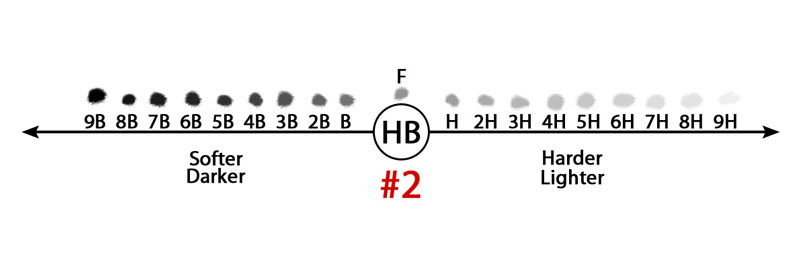
Drawing pencils are organized on a scale based on how soft or hard their graphite is. An "HB" (#2) pencil is in the center of the scale. The rest of the drawing pencils have a number plus either an “H” (for hard) or a “B” (for black) stamped on them. Below shows the variety available:

Graphite pencil scale of grades


If you start in the center of the diagram and move to the right, you see the designations for increasingly hard graphite pencils. If I want to make very light marks on a drawing, I might choose a 9H pencil. It works well for a beginning sketch because the marks are easy to erase without leaving a trail. When I want somewhat darker marks, but still lighter than a regular writing pencil, I would use a lower-numbered H pencil.


Starting again from the HB pencil in the middle of the diagram and moving to the left, are pencils with increasingly softer graphite. Those make darker marks with little pressure needed. I might use these to fill in some areas of a tree trunk or a dark shadow without having to use a lot of pressure. But the graphite is used up much faster than with harder grades of pencils. And I have to sharpen them more often to keep their points. 


And speaking of sharpening, if Richard was an artist, he might have learned to sharpen pencils. On the other hand, I would not have had hundreds of them to give to a school. And fewer pencils in my house might mean you would not know a 9H pencil from a 9B. Draw your own conclusions!


Read More

2/8/2020 7:09:04 PM

Who nose what will happen next?

Paula Willits / 4 Comments


                           OMG!         


There's nothing that makes you think of noses more than smashing your own. Take it from me.


About a week ago, I crashed into a closed sliding glass door and I've been thinking of noses ever since. I’ve even done some scientific research on trauma to the nose. Did you know that psychiatrists have identified 5 distinct phases you go through once you smash your nose into a door? They include, in this order:


1. Shock and Awe - actually spelled AHHHHHHHHH!!!!!!

2. Examining the Damage. Is blood gushing out? Is my nose now crooked? Is there swelling?

3. Denial. I can’t be stupid enough to walk into a closed door.

4. Acceptance. Yes, I am stupid enough to walk into a closed door.

5. Finding the silver lining. For example: the topic for my blog this month is....


(drum role here)


ANIMAL NOSES!


Before I specifically address noses, a little background information on me might help you understand this month’s topic.


I loved all kinds of critters as a little girl. I even hunted for lizards, frogs, toads, bugs and turtles with the boys. And I was thrilled when a boy in my 4th grade class gave me a baby snapping turtle. He was so cute (the boy AND the turtle)! 


Once I deposited the captured reptiles and amphibians into appropriate terrariums, I could sketch them at my convenience. I particularly admired the professionally drawn and painted images in the Reptiles and Amphibians paperback book by Herbert S. Zim and tried to copy its detailed renderings throughout. 


I even attempted to capture birds, because my father told me all I’d have to do is sprinkle salt on their tails and they wouldn’t be able to fly away. It took me a year or so and lots of wasted table salt to get the joke.


Now I know I don’t have to catch birds to paint them. In fact, I just completed a commission to paint a Tricolored Heron that I can’t imagine confining in a cage! 


And who among us would sentence this Wild Canary I painted to life in a gilded jail?


When I was about 11, I started sketching larger animals after reading The Jungle Book. I remember working on lions, tigers, elephants and zebras to add to my required book report. My grades on book reports definitely improved when I added the art, so there was another incentive to keep me sketching and painting. 


But back to animal NOSES. Have you ever noticed the different shapes noses take in nature? 


Even dogs have noses unique to their breeds. 


So here’s a little test of your nose knowledge. Can you identify the animals that sport the noses I sketched below? After you come up with your answers, check your accuracy in the numbered list below. NO CHEATING! Try your best before looking at the answers. But you are allowed to grade your own test!


1. Rabbit. 2. Pug. 3. Soft Shelled Turtle. 4. Horse. 5. Elephant Seal. 6. Box Turtle. 7. Mouse. 8. Lizard. 9. Eagle. 10. King Charles Cavalier (Yes! Their noses actually are heart-shaped!) 11. Sea Nose Fish


Let me know how you did on my quiz in the comments section below. And contact me at [email protected] if you’d like me to sketch your pet’s nose — and face too — for a portrait!


Read More

1/13/2020 12:58:35 PM

The Death of Roomba: Lessons Learned

Paula Willits / 2 Comments


The holidays are over, and hopefully you received some presents you really wanted. I say that because you’ve heard about husbands giving their wives “useful” things for Christmas such as vacuum cleaners. I even remember when a certain relative gave his wife - who was always fighting to lose weight - a scale for Christmas. Can you imagine? Believe it or not, the marriage survived. 


But I digress.


The truth is, I actually requested a vacuum as a gift a few years ago. I really did want a Roomba. It’s the robot vacuum that does the work for you. Once that vacuum came into our home, I was so happy happy with it, that over time I became the proud owner of a family of Roombas — three robots that now make it possible for me to keep breathing in a house filled with dog hair. (I have learned the hard way that certain breeds of dogs shed no matter what you do to try to prevent it.)


The good news is my Roombas go about their business regularly sucking up the fur as it gently floats across the floor. And they don’t even complain about their workload or ask for worker’s comp if they are injured on the job. Of course, you are thinking, they can’t talk. But that’s not true. Roomba owners know these electronic slaves actually do say a few words now and then. For instance: “Please charge Roomba!” or “Please move Roomba to a new location and press charge!” I dutifully comply since they are so polite.


But imagine my surprise this holiday season when I heard a crashing sound from down the hall and my Roomba went silent. Then I heard a long, sad moan. I raced to investigate. The Roomba in my master closet was not simply resting. Instead, it had caught a cord hanging down from my clothes hamper and then tried to suck it in. The cord was attached to a small lamp, which then crashed down on top of Roomba. Glass shards from the lightbulb were strewn about: There had obviously been quite a struggle. 


I quickly unplugged what was left of the lamp, and then gently picked up Roomba. I feared he/she/it might have unintentionally ingested some glass. Now here’s the weird part: As I lifted Roomba, I heard a deep, creepy voice from within the robot say “English! Haunted!” Then Roomba’s lights went out and there was nothing but silence. 


What did those two words mean? Was I part of a murder mystery where Roomba was desperately trying to give me a clue before it crossed the Jordan? I pushed a few buttons on its face, shook it gently to loosen some glass shards, and then carefully stepped out of the closet and into my office where I began to make arrangements for a decent funeral. Of course, the hardest part would be explaining to the rest of the Roomba family that one of their kind had passed due to my negligence in not unplugging that lamp.


So what does this murder mystery have to do with art? Here are my thoughts:


1. Embrace the unexpected. The broken glass that killed Roomba could find it’s way into a mosaic!

2. Mistakes can mean a good outcome in art. I’ve learned that when my brush slips or paint drips where I didn’t want it, the effect - though unintended - can be just what a painting needs to be exceptional. 

3. I should have carefully prepared the environment before having Roomba go to work. Likewise, the “groundwork” of composition - deciding how elements of a painting will be arranged - is often time consuming, but is time well spent. And doing thumbnail sketches and trying out different color schemes before starting a painting also beats cleaning up a big mess later.


Now, with clear 2020 vision, I wish you all a happy, productive, and mistake-filled new year!


Read More

12/8/2019 4:43:35 PM

Is Your Dog Camera Shy?

Paula Willits / 2 Comments


Do you ever get frustrated with your dog when you’re trying to take his or her photo? I sure have. Let’s face it, dogs rarely pose. And even those few who actually smile seldom do so on cue. In fact, it seems like my dogs go out of their way to blink or look away at the critical second — just when the camera clicks!


You might wonder why I’m blogging about taking dog photos instead of addressing how to paint dogs. The truth is, I need a good photo to be able to paint a dog well, because our canine companions quickly tire of sitting still for an artist. In fact, they don’t know or care about the term “pose.”  But the quality of your fur baby’s painted portrait starts with the quality of the photo reference.


That’s why, if you commission a portrait of Fido, the artist’s first question is likely to be, “Do you have a good photo of him?” And if your answer is “no” the next step is to snap some, if the dog is available.


Unfortunately, you may not know what makes a photo “good” for an artist’s reference, or how to convince your pet to care. I sure didn’t until I began to paint dog portraits!


The most important tip I can offer is to get down to the dog’s level. Photos taken by someone towering over a dog yield strange perspectives and little detail of those sweet, expressive eyes we all love. Dogs’ noses are also a big part of who they are and they can best be seen close-up. If you have trouble kneeling or even lying down in front of your pet to get the best shot (think Chihuahua), put the dog on his favorite chair or sofa, sit on a chair in front of him, and let the photo session begin!


But wait! There’s more! Even with the dog and photographer at eye level, there is no guarantee of a great photo.


Dogs, like people, all have different personalities. Some, like my two angels (ha!), are insanely food-driven. Once I accepted that fact, my photo battles were over. Show Sugar and Cinnamon some dry pellets and they become soldiers at attention!


Others aren’t that motivated by treats, but bring out a ball or favorite squeaky toy and they will perform like trained seals.  And still others react well to intriguing sounds, such as birds tweeting, a horn honking, or other dogs barking.


Think about what motivates your pet and then bribe, bribe, bribe!


If you find it hard to hold an iPhone or regular camera steady while manipulating whatever your pet loves, have someone stand behind you to direct the pet’s eyes. Your helper can get the dog’s attention using animal sounds from an iPhone’s app, or food, the family cat or bird (as long as they are held safe), or a favorite toy.


Finally, remember that dogs are emotional sponges. If you get anxious or impatient, they will sense it and react accordingly. That lesson came home to me when I tried to capture the perfect shot of a little Yorkie so I could do his portrait. After racing from one room to another taking about 50 mediocre photos, I finally gave up. As I relaxed and chatted with his owner, I happened to look down and saw the most perfect expression on the little dog’s face. He, like I, had relaxed! That shot ensured a portrait that reflected his sweet personality.


 With no film to buy or have developed, I believe cellphones were invented to memorialize dogs.  (I have at least 1,000 photos of Sugar and Cinnamon on mine.) And now you have tips on how to get the winning shots!


Now there’s just one more thing to remember: Contact me if you decide you are ready to have your pet “sit” for his portrait.

Read More

11/8/2019 12:44:51 PM

WIN A FREE PAINTING! Do you still see the paintings on your walls?

Paula Willits / Comment on this

I bet you remember Jackson Pollock, the artist who became internationally famous for pouring and dripping paint onto huge canvases. But could you describe a single painting he did, other than saying it had colored drips and splats all over it? I think not. And I think if you had the funds to purchase one of his originals, you would soon not even look at it. It would more or less become wallpaper. 


At the opposite end of the “pour and drip” artwork spectrum are canvases with solid blocks of color often found in modern art museums. Do you wonder, as my husband does, whether they’re really art? His definition of art is if he could do it, it isn’t art. I laugh at that comment, even after hearing it for more years than I care to recount. The truth is, I see more than just a solid color. I often note texture and tiny rivers of slightly different shades of the overall color. Still, I’ve never been tempted to buy one because I know it too would soon become wallpaper. 


I want customers who purchase my art to enjoy it for years, not just when it’s new. That’s why I often add “surprises” within my compositions to keep viewers’ interest. Perhaps the best example of that strategy is the painting below, where I embedded a lot that isn’t obvious at first glance. I’m betting you will see something different almost every time you pass it. And it will be a “conversation piece” when visitors spot it.


“What Do You See?” has many embedded surprises!


Enlarge the photo (touch the middle of the image with 2 fingers and gently slide them in opposite directions.) The whole image is best viewed on a PC or an iPad. If you are viewing it on a cellphone, enlarge one area at a time.


The first time people see this painting,  they almost always mention the vivid colors and the intricate designs throughout. And most ask me how long it took to paint. But there’s more to consider. There are objects (cartoon style) hidden among the abstract designs. Can you find them? (HINT: Ignore the circles and scattered flowers and vines.)


Here’s something to get you started: Can you find a group of 4 men with their white socks and blue shoes? 


Congratulations if you spotted the little men! If not, look on the left of the image where they’re peering over a red and yellow swirl just below the midpoint of the painting.


Now here’s another surprise: The first 3 people to email me what 5 ANIMALS (includes insects) are hanging out in the painting will be declared the official winners of my first online art contest. Do I hear a drum roll and cheering?


To play: email your list of 5 animals and/or insects to [email protected].

(The little men — or any human images — don’t count.)


The winners will be announced by email to all who enter the contest. 


Each winner may choose 1 painting. The first person to correctly name the 5 hidden objects will choose 1 painting from all 3 prizes. The second winner may choose from the 2 paintings left. The third winner will receive the painting not yet chosen. 


Here are the 3 prizes:


“Sunset on the Seine” (16” x 20” canvas reproduction, signed by the artist. The image continues on all sides.)


“The Village” (16” x 20” canvas reproduction, signed by the artist. The image continues on all sides.)


 “Going Fishing” (16” x 20” canvas reproduction, signed by the artist. The image continues on all sides.)


Good luck to all participants!! Do you hear the starting trumpet sounding?


“What Do You See?” is available for purchase on this website.


Tap “Works” on the homepage. Then choose “Abstracts.”


Or contact the artist at [email protected] for more information. 


13 1/2” x 27 1/2”, acrylic on canvas with a black/gold “floater” frame included.

Many layers of crystal-clear varnish make this work look like it’s made of porcelain. 


Read More

10/13/2019 8:42:52 PM

Why I like creating abstracts

Paula Willits / Comment on this

When I was much younger, I enrolled in a pottery class offered at a local ceramic shop. At the first meeting, an artist demonstrated how to create a clay pot on a pottery wheel. It looked so easy to do, and like so much fun! I could almost feel the cool, wetness of the clay as the artist gently shaped it while pumping a lever with her foot to make the wheel spin. Remember the scene from the 1990 movie “Ghost” when Whoopi Goldberg created pots on that wheel? I wonder how many thousands of fans tried the pottery wheel after that? But I digress.


My experience working on the pottery wheel was quite different! Under my hands, the  “wannabe” pot remained a misshapened glob of clay, off-center and doomed to be thrown back into the mother lode of wet clay still in the big tub where it came from. But I reframed the experience. As I looked at the ceramic shop’s shelves, I decided if I became really good at making pottery, my work would look just like all those other pots on the shelves. I, on the other hand, wanted to create something original. With that thought in mind, I said adios to the pottery wheel and began shaping some cute little primitive birds with my hands. Today, those 4 little birds decorate a table in my den. And I still enjoy them. They are one of a kind.


So what does this have to do with creating abstract paintings? Actually, a lot. 


I was inspired to start painting abstracts after I asked an artist at an art festival why he chose that style. “If I do realism well, it looks exactly like what I’m painting. And for centuries, thousands of artists have been able to copy what they see. There are no surprises at the end. It gets boring to me and to those who buy it,” he said. “I want to create art that evolves as I do it. I never know how they’ll turn out!” he said with a broad smile. “Abstracts allow me to use my creativity and show emotion,” he added.


That sounded like a call to action to me! I immediately created two acrylic abstracts that won prizes at local art shows. Many people who saw them commented on how they stood out from the other entries not only because of their bright colors, but also because they were so different from the other entries — most of which depicted realistic objects  or landscapes. 


Although I enjoy painting in a variety of styles, I must admit I like painting abstracts most of all. It’s challenging to capture the emotion in what I see and “edit out” what is confusing, distracting or unnecessary to the composition rather than seeking photo realism. And heck, I paid a lot for my iPhone, so I will leave the photo-realism to the actual photos!


I also enjoy experimenting with colors and shapes rather than being tied to what is realistic. Here’s one of my latest abstracts. 


A View from the Top


I’m not a big hiker. But I would love to be transported to the top of a mountain to enjoy the view. Perhaps the world would look as magical as I envision it in this abstract. It’s painted with acrylics on canvas , is  37 1/2” x 37 1/2”, and is framed in a custom-made gold and black floater frame. 


Find this painting in the “Abstracts” section of my website at paulawilllits.com or contact me for more information at [email protected].

Read More