A moving discovery: pencils, pencils, and more pencils

Shelter in place activity: Build a house of art pencils!
The pencils are at it again: reproducing when I’m not looking. They’re hiding in dark drawers. In every nook and cranny. And even in the so-called “pencil holders” (that don’t seem to hold them) on every desk and counter in my house.
For more than 7 years, the growth of the pencil population in my house had gone unchecked. But then I was on to them. We were getting ready to move, and that meant opening all those dark drawers and rarely used cabinets and shelves, and every other place that might be harboring them.
I found long pencils with plump, fresh pink erasers. And little “half” pencils with no erasers that looked like what golfers use to keep their scores. But we don’t play golf, so I could only guess that they were the offspring of the larger “parent” pencils. And finallly, there were the medium length pencils with half worn-off erasers. You know, the “senior” pencils.
Almost all the pencils I found had one thing in common: They were not sharp. Their points had seen better days. They were languishing in the dark recesses of the house, hoping they would be chosen for some use to make them feel important. And while they waited, they were reproducing out of boredom.
I actually found more than 200 #2 pencils. Although I sometimes “embellish” my stories, this time I am not exaggerating. Why oh why (said with a moan) did our pencil population get so out of hand? I don’t even like to use pencils for writing notes!
I prefer to use one of the 160 ball point pens I found hanging around waiting for their chance to shine.

Some #2 pencils enjoy a rare day out cheering for the Gators!

A small sampling of the hundreds of pens lounging around our house.
I heard their desperate cries: “Pick me!” “Pick me!”
Since my dogs don’t have opposable thumbs, or money to spend on buying anything, I sought out the only other possible culprit in the proliferation of our pencil population: my husband Richard. “Why do you have all these pencils in your desk drawers?” I asked. “Do you just buy more when you can’t find a sharp one?” His answer: “I’m not good at sharpening pencils.”
Truly, that was his actual answer. But I spotted a dusty, electric pencil sharpener within his reach.
Perhaps a few lessons in pencil sharpening were in order?
While I was bundling pencils to take to a local elementary school and thinking about how Richard did not appreciate my lectures, I decided to write about artists’ drawing pencils — but I used a keyboard instead of interrupting the everyday pencils still doing who-knows-what in the dark.
Pencils with a mission: to draw
The bright yellow pencils that populate my house have a #2 stamped on the end. They all have graphite encased in wood, even though we call them “lead” pencils. Graphite’s a type of carbon that’s safe to use.
Most pencils made specifically for artwork also have numbers on one end, but some simply have “HB” stamped there. That’s the same degree of graphite softness as the #2 pencils we use for writing. But other artists’ pencils have different letters and numbers on them.
Drawing pencils are organized on a scale based on how soft or hard their graphite is. An "HB" (#2) pencil is in the center of the scale. The rest of the drawing pencils have a number plus either an “H” (for hard) or a “B” (for black) stamped on them. Below shows the variety available:
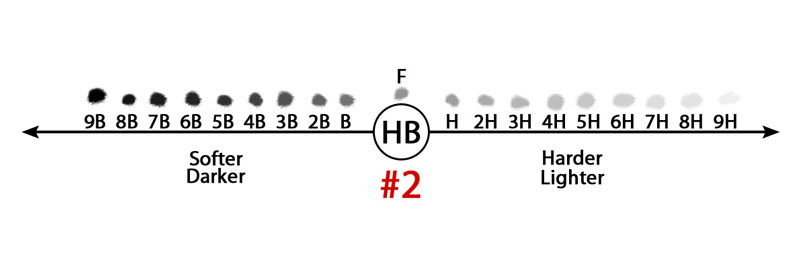
If you start in the center of the diagram and move to the right, you see the designations for increasingly hard graphite pencils. If I want to make very light marks on a drawing, I might choose a 9H pencil. It works well for a beginning sketch because the marks are easy to erase without leaving a trail. When I want somewhat darker marks, but still lighter than a regular writing pencil, I would use a lower-numbered H pencil.
Starting again from the HB pencil in the middle of the diagram and moving to the left, are pencils with increasingly softer graphite. Those make darker marks with little pressure needed. I might use these to fill in some areas of a tree trunk or a dark shadow without having to use a lot of pressure. But the graphite is used up much faster than with harder grades of pencils. And I have to sharpen them more often to keep their points.
And speaking of sharpening, if Richard was an artist, he might have learned to sharpen pencils. On the other hand, I would not have had hundreds of them to give to a school. And fewer pencils in my house might mean you would not know a 9H pencil from a 9B. Draw your own conclusions!
Read More
